 WhatsApp

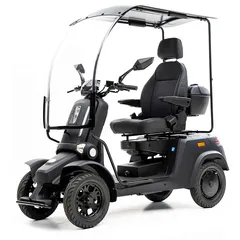
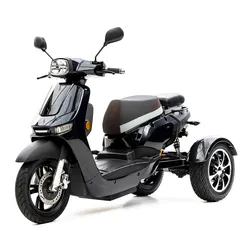
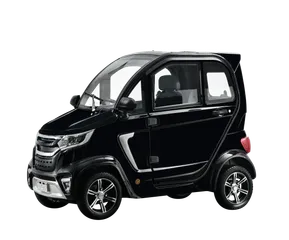
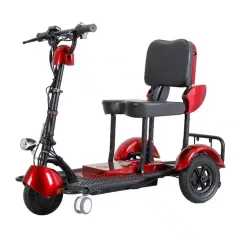
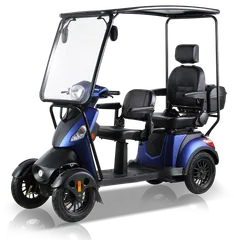
Two or three models side by side, in the figures For Motion states itself.
How to compare fairly
Figures only mean something once you know your own journeys. Four steps, then the table.
1. Your journeys
Write down the run you make most often, there and back, with the surface: cobbles, kerbs, a bridge. That gives you the minimum range you need.
Write down the run you make most often, there and back, with the surface: cobbles, kerbs, a bridge. That gives you the minimum range you need.
2. Wheels and transport
Three wheels turn tighter, four sit steadier on longer and rougher runs. Does it have to go in the car? Then weight matters more than anything.
Three wheels turn tighter, four sit steadier on longer and rougher runs. Does it have to go in the car? Then weight matters more than anything.
3. Weather protection and the class
Open, with a canopy, or enclosed — take what you will actually use all year. Then check the class: a body or wider armrests push up the width and the unladen weight, and 0.85 m and 150 kg are class 3 limits.
Open, with a canopy, or enclosed — take what you will actually use all year. Then check the class: a body or wider armrests push up the width and the unladen weight, and 0.85 m and 150 kg are class 3 limits.
4. Two finalists, two quotes
Narrow it to two models and have a quote written for both. Two full prices and two class statements side by side decide more than any specification sheet.
Narrow it to two models and have a quote written for both. Two full prices and two class statements side by side decide more than any specification sheet.
Compare models
The three most-chosen models are loaded by default; swap them for whichever you like.
| Feature | 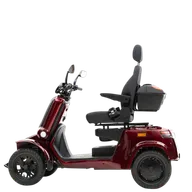 Forty-5View the Forty-5 | 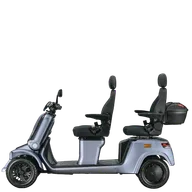 Forty-5 DuoView the Forty-5 Duo | 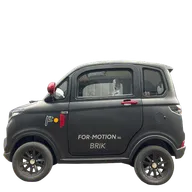 BrikView the Brik |
|---|---|---|---|
| Your choices | |||
| Type | 4 wheels | 4 wheels | 4 wheels, with cabin |
| Colours | 4 colours: Bordeaux Red, Matt Blue, Matt Black, Ocean blue | 4 colours: Bordeaux, Metallic blue, Ocean Blue, Black | 3 colours: Matt black, Gloss black, Bordeaux red |
| Speed configurations (above 8 mph: private land only in the UK) | 5 up to 28 mph (7 settings) | 8 up to 28 mph (5 settings) | 15.5 or 28 mph |
| Battery choice | standard 30Ah · 25 miles, up to 160Ah · 186 miles (optional extra) (best of the three) | standard 40Ah · 31 miles, up to 80Ah · 124 miles (optional extra) | standard 100Ah · 56 miles, up to 280Ah · 174 miles (optional extra) |
| Riding and charging | |||
| Range (as stated) | 25 - 186 miles (best of the three) | up to 186 miles (best of the three) | 56 - 81 miles |
| Battery (standard) | Available in 20, 40, 60, 80, 120, or 160Ah – 60V. | 40, 60, 80, 120 or 160 Ah – 60V | 60V / 100Ah lithium |
| Motor | Two motors, 800W each (total 1600W). | Two motors, 1200 watts each | D/C 2000W |
| Charging time | — | — | 4–5 hours |
| Climbing ability | — | — | 25° |
| Space and size | |||
| Seats | 2 people | 2 people | 3 people (best of the three) |
| Dimensions (L × W × H) | L: 2150 mm (1900 mm excl. basket), W: 740/800 mm, H: 1480 mm, Seat height: 750 mm, Turning radius: 6 m, Capacity: 1–2 persons. | — | 2350 x 1100 x 1530 mm |
| Seat height | 750 mm | 750 mm | — |
| Turning circle | 6 m | 6 meters | — |
| Weight | — | — | 350 kg |
| Maximum load | — | — | 150 kg |
| Technology | |||
| Brakes | Disc brakes front and rear. | — | Hydraulic |
| Suspension | Independent suspension front and rear. | Independent suspension front and rear | Front and rear |
| Tyres | — | — | 12 inch |
| Comfort and equipment | |||
| Air conditioning | — | — | Not available |
| Reversing camera | — | — | Included |
| Multimedia | — | — | MP3 & Bluetooth |
| Windscreen wiper | — | — | Included |
| Lighting | — | — | Front and rear |
| USB socket | — | — | Yes |
| Alarm | — | — | Included |
| App connection | — | — | Included |
| Optional extras | |||
| Roof / canopy | — | optional extra | — |
| Seat heating | — | — | optional extra |
| Foot throttle, left | — | optional extra | optional extra |
| Brake pedal left or right | — | — | optional extra |
| Thumb throttle | optional extra | optional extra | — |
| Charging-point adapter | — | — | optional extra |
| Removable battery | included | included | — |
| Walker holder | optional extra | optional extra | — |
| Wheelchair holder | included | — | — |
| Walking-stick holder | optional extra | optional extra | — |
| Windscreen | optional extra | optional extra | — |
| Extra tyres | — | optional extra | — |
The same on all three: top speed as built (above 8 mph: private land only in the uk) 28 mph · comfort seat optional extra · fast charger optional extra · gps tracker optional extra · tracking beacon optional extra · phone holder optional extra · 12 v socket optional extra · lock or wall anchor optional extra.
From each model's own specifications and configurator; range depends on the battery pack, the weight carried and how you ride. Still unsure? The buying guide weighs up your journeys, and a written quote puts the full price of either model in front of you.
How far would you really get? An estimate
The stated range applies to normal use. Tick what applies to you; the factors are shown beside each one.
Forty-5: roughly 186 miles per charge (stated 186 miles). Choose a battery pack with a third in reserve on your longest ordinary journey.
Factors: the highest setting × 0.82 from For Motion's own Trion figures (43 miles at the high setting, 53 miles at the low one); the other three are estimates. More about batteries: mobility scooter batteries; further reading: all articles.
The comparison no table shows: the UK class
Two machines that look alike on paper can land in different places in British law, because the class turns on the number of seats, the width, the unladen weight and the speed the machine is incapable of exceeding. Before you choose between two models, compare this as well:
| Class | Driving licence | DVLA registration | Insurance | Helmet | Minimum age | Where you may ride |
|---|---|---|---|---|---|---|
| Class 2 — incapable of exceeding 4 mph | None | None | Not required by law, strongly recommended | None | None | Pavements, pedestrian areas and physically separated cycle tracks. On the road only to cross, or where there is no pavement. Never motorways, bus lanes or painted cycle lanes. |
| Class 3 — incapable of exceeding 8 mph; one seat, ≤ 150 kg unladen, ≤ 0.85 m wide | None | Compulsory — register with DVLA (form V55/MV, or V62 if the log book is missing). No vehicle tax to pay. | Not required by law, strongly recommended | None | 14 | The road, plus pavements at 4 mph with the limiter engaged and the speed indicator working. Never motorways. On a dual carriageway with a limit above 50 mph a flashing amber beacon must be used. |
| Above 8 mph, or wider than 0.85 m, or over 150 kg — not in a class | Compulsory — the category the vehicle is approved in | Compulsory | Compulsory once the total weight exceeds 254 kg, and wherever the machine is not used solely by the one disabled person it was built for — which includes any two-seater | Depends on the approval category the vehicle is registered in; it is no longer a mobility scooter question | The minimum age of that licence category | The carriageway only. No pavements, no pedestrian areas, no cycle tracks, no cycle lanes. |
Which class applies to a given model we tell you before the quote. The whole picture is on the page mobility scooter rules.
Sources: Use of Invalid Carriages on Highways Regulations 1988 · CSDPA 1970 s.20 · GOV.UK, the classes · GOV.UK, driving on the road · checked 13 September 2026.
Still not sure?
Three ways to make the decision.
The buying guide
Eight questions about your journeys, and you get the model that fits — with the class beside it.
Eight questions about your journeys, and you get the model that fits — with the class beside it.
A call to Heerde
Five minutes on the phone saves you a week of searching. We ride these machines ourselves.
Five minutes on the phone saves you a week of searching. We ride these machines ourselves.
Two quotes side by side
Have a quote written for both finalists. Two full prices, two class statements — and it usually decides itself.
Have a quote written for both finalists. Two full prices, two class statements — and it usually decides itself.
Common questions about comparing
What people ask with two models open in front of them.
We use your details only to answer your enquiry.
Free and without obligation
Two prices, one decision
Ask for a quote on each of your two finalists — the full price and the class, within one working day. Or ring us on +31 85 212 97 54.
Mobility scooter advice: plan your purchase
- Mobility scooter prices: compare the complete cost
- Mobility scooter batteries and charging
- Long-range mobility scooters: planning your trips
- Mobility scooter dimensions: doors, storage and access
- Folding mobility scooters: will it fit your car boot?
- Storing a mobility scooter at home
- 3-wheel vs 4-wheel mobility scooters
- Enclosed mobility scooters: choosing a cabin
- Two-seater mobility scooters: UK use and buying advice
- Buying a used mobility scooter: inspection checklist
- Comparing mobility scooter brands and models
- Mobility scooter accessories: what to check